Swinging after the doctor injected something into my right hand, I started to understand how light the grip should be and how relaxed one's hands and arms should be. Swollen and very sensitive to contact, my right hand hardly touched the grip, yet I hit my best shots in the backyard. I tried to feel completely relaxed and concentrate on turning the torso. See what you think.
Tuesday, July 30, 2013
Get Needled
After a visit to the doctor, my practice swing has never been better.
Swinging after the doctor injected something into my right hand, I started to understand how light the grip should be and how relaxed one's hands and arms should be. Swollen and very sensitive to contact, my right hand hardly touched the grip, yet I hit my best shots in the backyard. I tried to feel completely relaxed and concentrate on turning the torso. See what you think.
Swinging after the doctor injected something into my right hand, I started to understand how light the grip should be and how relaxed one's hands and arms should be. Swollen and very sensitive to contact, my right hand hardly touched the grip, yet I hit my best shots in the backyard. I tried to feel completely relaxed and concentrate on turning the torso. See what you think.

Saturday, July 27, 2013
The Long and Winding Road
The Beatles' song captures the situation. Now eight years and counting, the swing is improving, slowly, making me think often of the "10,000 Hour" rule. So, if the swing is ever going to happen, it might be sometime in the next two years. If it doesn't happen then, I should just retire and go back to tennis.
I haven't written in a long time, for two reasons. First, my employment situation improved, and second, the swing has been changing daily. A good thing, considering that I've been practicing like a maniac for six months. And it's been only in the last few weeks that I've felt that I'm on to something good. My practice has been mostly in the back yard, using plastic balls and Callaway practice balls and Almost Golf balls, hitting with a sand wedge and a nine-iron. This short game practice has returned generous rewards. When I go to the range (maybe once a week) for a "reality check," the results don't feel or look as great as they do in my own back yard, but I can see improvement.
Here are a couple of clips from my practice at the range today. You'll notice some good things and some things that I still need to address, but, in general, you'll see a better swing than I used to show here. Don't miss the woodchuck scurrying across the range as I get ready to hit my first shot. I never noticed him until I started editing the video. Obviously, he's learned that he's safer on the fairway than any place else. I've noticed that at Mohansic, my regular course, where deer feel perfectly safe out on the fairway, a target that golfers like me rarely hit.
The first shot, and the best, is a wedge. Everything looks pretty good here. In the next shots, you can see I'm trying to hit the ball. The swings don't look terrible--they're a big improvement over the way I used to "swing," but they're still rushed and incomplete in the follow-through.
I haven't written in a long time, for two reasons. First, my employment situation improved, and second, the swing has been changing daily. A good thing, considering that I've been practicing like a maniac for six months. And it's been only in the last few weeks that I've felt that I'm on to something good. My practice has been mostly in the back yard, using plastic balls and Callaway practice balls and Almost Golf balls, hitting with a sand wedge and a nine-iron. This short game practice has returned generous rewards. When I go to the range (maybe once a week) for a "reality check," the results don't feel or look as great as they do in my own back yard, but I can see improvement.
Here are a couple of clips from my practice at the range today. You'll notice some good things and some things that I still need to address, but, in general, you'll see a better swing than I used to show here. Don't miss the woodchuck scurrying across the range as I get ready to hit my first shot. I never noticed him until I started editing the video. Obviously, he's learned that he's safer on the fairway than any place else. I've noticed that at Mohansic, my regular course, where deer feel perfectly safe out on the fairway, a target that golfers like me rarely hit.
The first shot, and the best, is a wedge. Everything looks pretty good here. In the next shots, you can see I'm trying to hit the ball. The swings don't look terrible--they're a big improvement over the way I used to "swing," but they're still rushed and incomplete in the follow-through.
Saturday, February 2, 2013
Slough of Despond
Lately, I've been thinking of editing the title of this blog from "learning a good golf swing is difficult, but realistic" to "learning a good golf swing is not only difficult—it's nearly impossible." When I think about a real swing, I'm reminded of the "Slough of Despond" in John Bunyan's Pilgrim's Progress, the archetype of discouragement and demoralization.
As you know by now, from previous posts, I am a devoted student of the swing. I know much more about the swing than I can actually perform. That's probably true of most golfers who take the swing seriously, but what I've been learning over the past few months is that the familiar credos about the swing are sayings that I thought I knew, but really didn't. Often, lately, I find myself thinking, "Oh, that's what that means!" At the same time, I'm realizing that what I thought I knew and had incorporated into my swing was something that I really didn't understand and wasn't performing. In other words, in trying to learn the golf swing, you think you know something about it, but you really don't: a perfect George Carlin moment.
So, I haven't written for a long time, mainly because things were changing so quickly that keeping up with them would be a full-time job, and I already had one. Also, my efforts weren't getting me anywhere fast.
Then I had my "Aha!" moment back in the fall, when a video of my "swing" showed me that I didn't have one; I was all arms, hitting at the ball. Casting, hitting way behind the ball, losing clubhead speed way before impact. Powerless effort instead of effortless power. Then, in my customary fashion, I decided that I couldn't live with this and went to a new pro to work on developing a real golf swing.
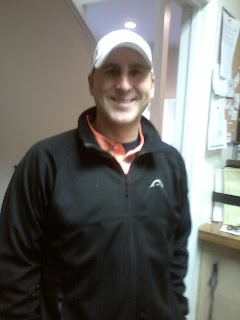 The new pro was Dante Antonini, who came from Knollwood CC to be the full-time pro at Yorktown Baseball and Golf (and on Facebook). He has a great swing (which I recognized from a distance the second I saw it when I drove into the parking lot) and devotes himself to helping everyone who shows up at the range. So I immediately bought a series of lessons. And he told me what I needed to know. The trouble is that I can't do what the golf swing demands.
I don't even understand what the golf swing demands. But, whatever it is, I can't do it. And neither can practically every other golfer on earth. I looked into the statistics. Leaving out the PGA stats on golfers with handicaps, or indexes, this is what it comes down to. From a Website I found, these are the discouraging numbers. If there were 1000 golfers on the planet, only ten percent of them would ever break 90. Of those, only ten percent would ever break 80. And we're not talking about averages here. Would EVER break 80. And of those, only ten percent would ever break 70. And of those, only a very small percentage would make it onto the PGA Tour.
Those numbers confirmed for me that learning a good golf swing is virtually impossible. Very few human beings can do it. Once I realized this, I decided that there is no point in taking my quest for a golf swing so seriously. I could try to teach my wife how to play tennis, for example. I used to be a decent player, and I understand the tennis strokes and could teach them to someone else, but I don't know how to hit a drive 250 yards.
As a result, my life is returning to normal. The golf swing is on the back burner. I still go to the range, maybe once a week, usually less now that winter temperatures are often below 30 degrees, and I have a nine-iron in my living room so that I can rehearse swings.
Trying to learn a good golf swing is an addiction, and I'm an addict. So, instead of going to the range at every opportunity, I've been Googling the swing. I'm more interested in a "Virtual Swing." And I've been looking at all the hits on the "Double Pendulum" swing. It makes all kinds of sense to me, in a theoretical way, but the only people I see actually doing this are on the PGA Tour. I don't see anyone at the range swinging like this. The only one I see is my pro, Dante. And in the early spring, some college and high school teams come to the range to get ready for their season.
As I told an acquaintance yesterday, forget about golf. Take up boxing.
As you know by now, from previous posts, I am a devoted student of the swing. I know much more about the swing than I can actually perform. That's probably true of most golfers who take the swing seriously, but what I've been learning over the past few months is that the familiar credos about the swing are sayings that I thought I knew, but really didn't. Often, lately, I find myself thinking, "Oh, that's what that means!" At the same time, I'm realizing that what I thought I knew and had incorporated into my swing was something that I really didn't understand and wasn't performing. In other words, in trying to learn the golf swing, you think you know something about it, but you really don't: a perfect George Carlin moment.
So, I haven't written for a long time, mainly because things were changing so quickly that keeping up with them would be a full-time job, and I already had one. Also, my efforts weren't getting me anywhere fast.
Then I had my "Aha!" moment back in the fall, when a video of my "swing" showed me that I didn't have one; I was all arms, hitting at the ball. Casting, hitting way behind the ball, losing clubhead speed way before impact. Powerless effort instead of effortless power. Then, in my customary fashion, I decided that I couldn't live with this and went to a new pro to work on developing a real golf swing.

I don't even understand what the golf swing demands. But, whatever it is, I can't do it. And neither can practically every other golfer on earth. I looked into the statistics. Leaving out the PGA stats on golfers with handicaps, or indexes, this is what it comes down to. From a Website I found, these are the discouraging numbers. If there were 1000 golfers on the planet, only ten percent of them would ever break 90. Of those, only ten percent would ever break 80. And we're not talking about averages here. Would EVER break 80. And of those, only ten percent would ever break 70. And of those, only a very small percentage would make it onto the PGA Tour.
Those numbers confirmed for me that learning a good golf swing is virtually impossible. Very few human beings can do it. Once I realized this, I decided that there is no point in taking my quest for a golf swing so seriously. I could try to teach my wife how to play tennis, for example. I used to be a decent player, and I understand the tennis strokes and could teach them to someone else, but I don't know how to hit a drive 250 yards.
As a result, my life is returning to normal. The golf swing is on the back burner. I still go to the range, maybe once a week, usually less now that winter temperatures are often below 30 degrees, and I have a nine-iron in my living room so that I can rehearse swings.
Trying to learn a good golf swing is an addiction, and I'm an addict. So, instead of going to the range at every opportunity, I've been Googling the swing. I'm more interested in a "Virtual Swing." And I've been looking at all the hits on the "Double Pendulum" swing. It makes all kinds of sense to me, in a theoretical way, but the only people I see actually doing this are on the PGA Tour. I don't see anyone at the range swinging like this. The only one I see is my pro, Dante. And in the early spring, some college and high school teams come to the range to get ready for their season.
As I told an acquaintance yesterday, forget about golf. Take up boxing.
Monday, October 8, 2012
Lag, Tempo, and Transition
The last few weeks have been practice time. No playing. Just work on tempo. And as I did that, I remembered transition and started paying attention to that, too. And as I worked on both, I started to feel how to maintain lag. Video was crucial in making progress. Otherwise, I judged myself by ball flight, which misled me. I thought I was hitting the ball well, but, really, I was hitting, rather than swinging and losing distance and consistency as a result. It took me a few weeks to get the feel of a slower tempo and transition, but once I did, progress was steady. Today gave the best results, as you'll see in the video. For the first time, I could see that my core was moving more slowly and that the club was actually swing around me. That was a very exciting video clip. Then I took my backyard swing to the range. Immediately, my tempo and transition disappeared. Hitting real golf balls, I forgot all about swinging and went back, instinctively, to hitting. Fortunately, I had the camcorder, which showed me the regression. I was able to make some adjustments, but the swing was never as good as it was in my backyard. In the clip, you'll see the differences between the backyard and range swings.
Sunday, September 16, 2012
Quasimodo's Swing
In my last post, I mentioned Jeff Mann's valuable Website. On this page, where he talks about "the kinetic sequence." Since then, I've come to realize how much his paragraph on "the rope handle technique" has helped me in the last few days.
When the left arm freewheels towards impact, it pulls the lagging club via the left hand, and this type of swing action is called the rope handle technique. In other words, the club is passively pulled along by the left hand - as if the golfer was simply pulling a piece of rope (like church bell ringers in the medieval era who pulled the bell rope in a groundwards direction in order to get the church bells to ring). At the end-backswing position, a modern, total body golfer usually has a 90 degree angle between the clubshaft and the left arm, and when the left hand pulls the grip end of the club during the downswing, the grip end of the club must obviously move as fast as the left hand. By contrast, the clubhead end of the club has inherent inertia and it lags behind the grip end of the club during the downswing.This is a fantastic analogy, a key to my growing understanding of lag. When I emailed Jeff about something he wrote about the left arm "catapulting" into impact and follow-through, he promptly wrote me back with a revision. I haven't gone through this paper, but I'm looking forward to it.
In my practice, when I can remember to think of the grip as a rope, the results are invariably good. Swing like Quasimodo. The trouble is that I don't always think of the rope because I'm also thinking about other things, like shifting my weight over my left ankle on the downswing, on keeping my weight back and off my toes throughout the swing, and on turning my hips and upper torso until I can't turn them any more. That's a tip I got from a recent Golf Digest article about Alvaro Quiros.
The video shows the state of my swing. From behind and from the side. There's also a side-by-side of the most recent swing and one that's just a few days older. You'll see quite a difference. The swing is different now, since I've been working on improvements since I took this video. I'll try to show the latest changes in a video in the next blog.
Thursday, September 13, 2012
"Overview of the modern, total body golf swing"
The title is from Jeff Mann's valuable Website. On this page, he talks about "the kinetic sequence of biomechanical events in the modern, total body golf swing," involving the pelvis, the shoulders, and the left arm. Jeff has the research and the technical understanding that confirms and explains what I've been learning lately.
 I've started to appreciate how good players get maximum clubhead speed. They do it in two parts. The first is turning the hips. This rotation brings the arms down to the "hitting position," where the clubshaft is parallel to the ground and target line. Then the second part picks up from there. This is the rotation of the upper body and shoulders. This speeds up the momentum that the first part already created and it concludes with that great finish position that the pros have, with their hips facing the target (or past that point in some cases) and the shoulders turned left and almost parallel to the target line. It's all one accelerating movement, though. In theory, or in teaching, it's two parts, but in practice these two parts are the swing, from start to finish.
Here's an excellent video analysis of Steve Allen's swing that captures what I think I'm learning. The instructor is Lawrie Montague from www.GolfConfidence.Org, but I think that what Lawrie misses as a teacher is what happens in the hitting zone. All he repeats is "swing through to the finish." But what drives that is the acceleration of the upper body and shoulders. I'm the golfer he talks about who thinks of hitting the ball, rather than swinging. What will make me more of a swinger is the idea of continuing to rotate the upper body and shoulders. It's just like doing "Around the World" with a yo-yo. In order to get the yo-yo to continue down and around, you have to speed up the finger that touches the string.
Now this is all easier said than done. It's one thing to analyze the swing and see how it probably works, and it's completely another thing to go out and try to do that. To put all this together requires breaking it down into parts and practicing those with drills and slow motion, and then, gradually, trying to put it all together. That's what I'm doing each day at the range. But it's very difficult. I've slowed down my tempo and tried not to think about distance at all (that, in itself, is very hard to do!). But I need some drills.
You see, there's the hip movement, which is hard enough -- Do I start with my left knee? Am I rotating level left? Has the transition happened? Am I just holding onto the club and dragging it? You get the idea. So you have to think about all that. Then, when the hips hit their 45 degree angle to the target line, that's when the upper body takes over. Well, how exactly do you make that happen? I don't know. It's a mystery to me. But I know it when I see it.
It's like Geoff Ogilvy's swing on YouTube, one of my favorite videos. It's great when he finishes his swing and you can hear a spectator say, "Wow!" There's also a great Ernie Els swing that ends with a similar reaction from some onlooker. These are the swings I want to emulate. They are prime examples of "Effortless power, instead of powerless effort."
Here's an excellent video analysis of Steve Allen's swing that captures what I think I'm learning. The instructor is Lawrie Montague from www.GolfConfidence.Org, but I think that what Lawrie misses as a teacher is what happens in the hitting zone. All he repeats is "swing through to the finish." But what drives that is the acceleration of the upper body and shoulders. I'm the golfer he talks about who thinks of hitting the ball, rather than swinging. What will make me more of a swinger is the idea of continuing to rotate the upper body and shoulders. It's just like doing "Around the World" with a yo-yo. In order to get the yo-yo to continue down and around, you have to speed up the finger that touches the string.
Now this is all easier said than done. It's one thing to analyze the swing and see how it probably works, and it's completely another thing to go out and try to do that. To put all this together requires breaking it down into parts and practicing those with drills and slow motion, and then, gradually, trying to put it all together. That's what I'm doing each day at the range. But it's very difficult. I've slowed down my tempo and tried not to think about distance at all (that, in itself, is very hard to do!). But I need some drills.
You see, there's the hip movement, which is hard enough -- Do I start with my left knee? Am I rotating level left? Has the transition happened? Am I just holding onto the club and dragging it? You get the idea. So you have to think about all that. Then, when the hips hit their 45 degree angle to the target line, that's when the upper body takes over. Well, how exactly do you make that happen? I don't know. It's a mystery to me. But I know it when I see it.
It's like Geoff Ogilvy's swing on YouTube, one of my favorite videos. It's great when he finishes his swing and you can hear a spectator say, "Wow!" There's also a great Ernie Els swing that ends with a similar reaction from some onlooker. These are the swings I want to emulate. They are prime examples of "Effortless power, instead of powerless effort."
Wednesday, September 12, 2012
More on Swinging and Hitting
Back at the 202 range, I'm consistently hitting the ball well. The missing ingredient is distance. Or clubhead speed. Basically, I'm still in the hitting mode. Once I get to the ball, I'm done. I've worked on setup and take-away, and transition, and downswing, and turning the hips, and moving weight to the left side, and coming to the ball from the inside. All those things are now giving me good results. Everything except distance. And I couldn't understand that until recently. One of my teaching pros, Max Galloway, at Mohansic Golf Course, showed me the hitting zone a while ago, but I didn't understand what he was talking about. Now I'm getting back to the concept he demonstrated for me, and I'm starting to understand. It's going to take some time to work this into my swing, but it's definitely the missing ingredient.
Tonight, hitting another hundred balls, and working on rotating, I started to feel that the hips go only so far. Once they bring the arms to the hitting zone, then the upper body and shoulders have to take over and carry the swing all the way through to the finish. In my experience, this part of the swing is neglected in YouTube Videos. Max is the only pro who actually showed me how this part of the swing works. Then I found this YouTube video, which says it all. There isn't anything I disagree with or feel is left out. The model is the swing of the PGA touring pro Steve Allen with commentary by Lawrie Montague from http://www.GolfConfidence.Org.
Here again, though, Lawrie neglect what happens in the hitting zone. That's where there is tremendous acceleration, generated from the core upper body and shoulders. That is what the pros do. That's why they have these beautiful finishes. They accelerate so much that they can't help coming through all the way. Their hips are facing the target, their shoulders are almost parallel to the target line, and the club is way past their left shoulder. For years, I've wondered how they do that. Now I know.
I'm actually pretty surprised that people who teach the swing miss this element. It's there in very basic instruction for beginners. We all know how the swing gets to the transition, and then accelerates all the way around to a full finish. What the instructors don't tell us, though, is how that happens. Just think of doing "Around the World" with a yo-yo. That's how it works. Weather permitting, I'll go to 202 again tomorrow night and come back with more to say on this topic.
Tonight, hitting another hundred balls, and working on rotating, I started to feel that the hips go only so far. Once they bring the arms to the hitting zone, then the upper body and shoulders have to take over and carry the swing all the way through to the finish. In my experience, this part of the swing is neglected in YouTube Videos. Max is the only pro who actually showed me how this part of the swing works. Then I found this YouTube video, which says it all. There isn't anything I disagree with or feel is left out. The model is the swing of the PGA touring pro Steve Allen with commentary by Lawrie Montague from http://www.GolfConfidence.Org.
Here again, though, Lawrie neglect what happens in the hitting zone. That's where there is tremendous acceleration, generated from the core upper body and shoulders. That is what the pros do. That's why they have these beautiful finishes. They accelerate so much that they can't help coming through all the way. Their hips are facing the target, their shoulders are almost parallel to the target line, and the club is way past their left shoulder. For years, I've wondered how they do that. Now I know.
I'm actually pretty surprised that people who teach the swing miss this element. It's there in very basic instruction for beginners. We all know how the swing gets to the transition, and then accelerates all the way around to a full finish. What the instructors don't tell us, though, is how that happens. Just think of doing "Around the World" with a yo-yo. That's how it works. Weather permitting, I'll go to 202 again tomorrow night and come back with more to say on this topic.
Tuesday, September 11, 2012
All Right! All Right!
In my last post, I anticipated another 3500 hours of practice before I got the swing, a forecast both premature and pessimistic, as my practice at the 202 range this evening showed. That my swing is basically OK became clear yesterday when I was hitting plastic balls in the backyard.
My round with Gary and Al at Put Nash gave me the idea that I was missing whip, or clubhead speed, in my swing. With the plastic balls, I started experimenting with speeding up the hips and shoulder turn, with excellent results. The ball really started to take off. At 202, I extended that new understanding, which also gave me fresh insights into staying connected, and using the core muscles to swing the club. For the first time, I started to feel as though the turning was producing a quality, repeatable swing. I could feel my arms tight against my rib cage and my hips and shoulders swinging my arms through, lag preserved and the clubhead swinging through at the bottom of the swing arc of my hands. These shots went out straight and high. Just what I like to see.
Next post should be about speeding up the turn, accelerating the tempo. That should give me more distance. And I have to remember to relax. As my pro, Brian Lamberti tells me, "Stop thinking!"
My round with Gary and Al at Put Nash gave me the idea that I was missing whip, or clubhead speed, in my swing. With the plastic balls, I started experimenting with speeding up the hips and shoulder turn, with excellent results. The ball really started to take off. At 202, I extended that new understanding, which also gave me fresh insights into staying connected, and using the core muscles to swing the club. For the first time, I started to feel as though the turning was producing a quality, repeatable swing. I could feel my arms tight against my rib cage and my hips and shoulders swinging my arms through, lag preserved and the clubhead swinging through at the bottom of the swing arc of my hands. These shots went out straight and high. Just what I like to see.
Next post should be about speeding up the turn, accelerating the tempo. That should give me more distance. And I have to remember to relax. As my pro, Brian Lamberti tells me, "Stop thinking!"
Sunday, September 9, 2012
The 10,000 Hour Rule, or Swinging and Hitting
On a glorious day after tornadoes and torrential rain passed through, remnants of Hurricane Isaac, I played Put Nash again, full of confidence that I would play well.
 This morning, I practiced in my driveway (since the back yard was soaked from yesterday's storm) and worked on swinging and keeping the clubface square, with a 5-iron and the driver. That went well. Then, after working out, I went to the range at Yorktown Golf and Baseball Center to hit a hundred balls. Again, the swing felt good. I really felt competent and ready to shoot in the eighties.
Arriving early at Put Nash, I had plenty of time to practice putting and chipping and pitching, with the idea of settling down so that I could make some nice short-game shots out on the course. Everything checked out. Solid putts, and reliable, consistent chips and pitches.
 Then I went out. I joined Gary and George, his son (in eighth grade) and Al. After we teed off on one, I could see that Gary and Al could hit the ball with power and accuracy. Experienced golfers and good players to measure myself against. What soon became obvious was that there was no comparison. They had mature swings. I don't swing. I hit. Discouraged and frustrated, I thought of Malcolm Gladwell's Outliers and the "10,000 Hours Rule."
He shows how some remarkable people achieved their greatest accomplishments. Among them are The Beatles, Bill Gates, Bill Joy (legendary programmer of Unix and Java), Mozart, and Canadian hockey players. The common thread through all these success stories is "10,000-Hour Rule." In brief, it states that anyone who can put in 10,000 hours of dedicated, high-quality practice can become very good at any endeavor. When I read the book, I was thinking, specifically, of my attempt to learn the golf swing. According to my calculations, I've put in about 6500 hours of targeted practice so far ( about 20 hours per week or 1,000 per year). Comparing myself, then, to Gary and Al, another 3500 hours should just about do it. By that time, I should be pretty good. So that's three and a half years from now. Judging from what I could do today, that's a decent estimate.
With my "amazing" swing, here's what I was able to accomplish today.
Arriving early at Put Nash, I had plenty of time to practice putting and chipping and pitching, with the idea of settling down so that I could make some nice short-game shots out on the course. Everything checked out. Solid putts, and reliable, consistent chips and pitches.
Then I went out. I joined Gary and George, his son (in eighth grade) and Al. After we teed off on one, I could see that Gary and Al could hit the ball with power and accuracy. Experienced golfers and good players to measure myself against. What soon became obvious was that there was no comparison. They had mature swings. I don't swing. I hit. Discouraged and frustrated, I thought of Malcolm Gladwell's Outliers and the "10,000 Hours Rule."He shows how some remarkable people achieved their greatest accomplishments. Among them are The Beatles, Bill Gates, Bill Joy (legendary programmer of Unix and Java), Mozart, and Canadian hockey players. The common thread through all these success stories is "10,000-Hour Rule." In brief, it states that anyone who can put in 10,000 hours of dedicated, high-quality practice can become very good at any endeavor. When I read the book, I was thinking, specifically, of my attempt to learn the golf swing. According to my calculations, I've put in about 6500 hours of targeted practice so far ( about 20 hours per week or 1,000 per year). Comparing myself, then, to Gary and Al, another 3500 hours should just about do it. By that time, I should be pretty good. So that's three and a half years from now. Judging from what I could do today, that's a decent estimate.
With my "amazing" swing, here's what I was able to accomplish today.
- Giddy Up par 5 -- 4 and 2
- Israel's Climb par 4 -- 4 and 2
- Down & Away par 4 -- 2 and 3
- Sybil's Ride par 4 -- 3 and 2
- Pond Stop par 3 -- 1 and 3
- Arnold's Hideout par 4 -- 3 and 2
- Star par 3 -- 2 and 2
- Agor's Farm par 4 -- 3 and 2
- Tight Quarters par 4 -- 3 and 2
- Nature's Beauty par 4 -- 5 and 2
- Tompkin's Corner par 4 -- 6 and 2
- Bullet Hole par 3 -- 2 and 2
- Barn Shot par 5 -- 3 and 3
Here's my analysis. On only a few shots did I feel I made a really good swing. For the rest, I complete forgot the lessons from the range, which include pulling the handle through. I made only about two good, confident strokes. On all the others, I was tentative. On my first bunker shot, I jumped into it. On the second, I did a nice job.
Here's a good example of where I am now, at my best. On thirteen, I hit the drive well, but pushed it right. When I found my ball, I could see that I could hit it over some trees and actually shorten the hole. So I hit a 3-hybrid, a little fat, but it went straight, and I could hear the ball hit some branches in the farthest tree. When I got to my ball, it was on the cart path, so I took a drop. The next shot, a seven-iron from about 170, slightly uphill, cut through some high leaves and landed on the front of the green. From there, I three-putted, tentative all the way. It's a par-five. With any putting stroke at all, I could've saved par.
So here I am, at about 45 for nine holes. And here's a little history. Seven years ago, when I first started on this goal to learn the golf swing, I shot a 45. It was after my first lessons. Now, here I am, six years later, shooting the same 45. However, there is a difference. When I shot the first 45, that was the absolute best score I could have. Now, in contrast, a 45 seems to me a score that doesn't represent my best. Today is a perfect example. I think that today, I hit only one fairway, and maybe hit one or two greens in regulation. The short game felt tentative. In general, I can't maintain all the swing thoughts I had at the range.
Still, assuming that I could summon those range thoughts, I still don't have the tremendous whip that Gary and Al have. I know what it is. I just can't do it yet. In another 3500 hours of practice, we'll see.
Friday, September 7, 2012
In the Rough

On the grounds of Put Nash, I went to the putting and chipping green first, as all the experts tell you. The putter felt a little unsteady when I tried long putts. Hmmm. In my usual practice, I feel as though I can putt like Billy Casper. What gives? So I hit a few more long putts. All short. But at least those strokes reminded me to get my hands through the ball ahead of the clubhead. Some chipping and, my favorite, bump-and-runs, and I was all set. Ready for the first tee.
 Remembering times like this, I invariably think of an article I once read about the novelist, Carl Hiassen. You might know him. Strip Tease (movie with Demi Moore), Skinny Dip, Basket Case, and others. All in set in Florida, dealing with greedy land developers, corrupt politicians, and clueless cops. Very entertaining. Give him a try. I think I first got onto him after the 2000 presidential election travesty, when Florida became known, derisively, as Flori-DUH!
In the article, which was about Carl's golf game, the author quoted the caddie as saying, something like, "Yeah, he can play, but he can't score." I've remembered that ever since I first read it, and that caddie seems to stride down the course beside me, every time I go out.
Check out Carl's book on golf, The Downhill Lie: A Hacker's Return to a Ruinous Sport. One online review begins, "Arnold Palmer once said, 'Golf is deceptively simple and endlessly complicated. It is at the same time rewarding and maddening.'" As we all know, golf is a constant struggle. Which begs the question: "Why do we do it?"

 Lewis Black has one answer. Robin Williams has another. Golf makes good material for comedy.
Whenever I go out on the course, the gallery in my imagination includes Lewis and Robin and Carl and his caddie and Arnie. After many shots, there's a lot of shaking heads.
My gallery with me, I stepped up to the first tee. Here's how it went. "Best-ball" scoring. Or call it "Fantasy Golf". That is, if your ball is behind a tree, move it. If you hit into a hazard, hit another. Terrible chip or pitch? Do it again. If your putter hits grass first and the ball goes only halfway to the hole, bring the ball back and make another stroke. It's a lot like tennis, with two serves. The numbers below show strokes to the green plus putts. Each hole sports a local historical or geographical allusion. On three, Ryan joined me, a college student and very athletic, with a beautiful swing. When he gets serious about his game, he'll be really good.
- Giddy Up par 5 -- 6 and 2
- Israel's Climb par 4 -- 2 and 1
- Down & Away par 4 -- 2 and 3
- Sybil's Ride par 4 -- 3 and 2
- Pond Stop par 3 -- 1 and 2
- Arnold's Hideout par 4 -- 3 and 2
- Star par 3 -- 2 and 2
- Agor's Farm par 4 -- 6 and 2
- Tight Quarters par 4 -- we skipped this to get ahead of a slow group
- Nature's Beauty par 4 -- 2 and 1
- Tompkin's Corner par 4 -- 2 and 2
- Bullet Hole par 3 -- 3 and 3
- Barn Shot par 5 -- 4 and 2
This is a typical outing for me. It's so bad, I can't really keep score. Yet, there are some good shots. And a lot of anxiety. Especially in the short game. In my backyard or on the practice green, I feel competent, but as I address a chip or pitch or putt on the course, doubt dominates and bad things happen.
To get back to Carl Hiassen, my game is in the deep rough now, but All the practice and drills and lessons from Max Galloway at Mohansic and Brian Lamberti at Golfworx are definitely improving the swing. It's good enough to take out on the course now, and I need to get out and play as often as possible.
Thursday, September 6, 2012
What If Practice Never Makes Perfect?
 An unusual title? Sure. The rhetorical question begins a "Briefly Noted" in The New Yorker (Jul 30, 2012) of Leanne Shapton's Swimming Studies, a memoir in which "Shapton, a writer, artist, and former contender for the Canadian Olympic team, grapples with the habits she leaned as a teen-age competitive swimmer. Taught to value exertion and hard work over talent and pleasure, Shapton remains preoccupied, even as an adult, with time, sequence, repetition, deprivation, and pain. The intensity of competition heightens and subverts everything from body image to early-morning light." The minute I read it, I knew it described my struggle with the golf swing. The magazine in one hand on the Lexington Avenue 4 express train, I hazarded my balance—and the safety of my fellow commuters—to grope blindly in an outside pocket of my large commuter bag for a green marker pen to highlight this passage, already looking ahead to the end of the working day when I'd be back in my backyard practice area again, repeating the swing, videotaping myself, working on tempo and sequencing. Like anyone else who's seriously tried to learn a good golf swing, I've accepted imperfection. We know the answer to the question the New Yorker poses. Practice never makes perfect in golf. But we continue to practice anyway—relentlessly, stubbornly, assiduously. Like ancient mariners, we're sailing toward a receding horizon.
You'll notice that I haven't posted in quite a while. The habit of regular posting just got away from me, at first because my swing was changing almost daily, and I didn't see the point of a post that would be old the next day. Then, I just found other things to do, like watching YouTube videos. In the last couple of months, though, I started to feel a legitimate swing coming my way. Tonight, exhilarated at solving (I'm pretty sure) a nasty shank, I felt the full swing was there, for the first time, without any major flaws, and the video looked worth posting.
You'll see two swing thoughts I've been working on. One is posture, including bracing against the right leg on the backswing, and the other, making a relaxed, full swing , all the way through to a finish with my shoulders turned left of the target line. It's the swing of a neophyte, but it looks to me like one that's on the right track. The first shot shows some slow motion practice, an idea from a YouTube video of Ai Miyazato. The chair is helping me feel the right leg bracing instead of straightening during the backswing. Then, a full swing, looking pretty good until the follow-through, where you should see more extension in the hands as they come through and around. I also bang the mat a bit, which means I let the clubhead go too early.
In the background, on the stone wall, you'll notice this orange fireball. That's a New York sunset, a little after 7:00pm, like a huge laser from across the Hudson River. I took it as a good omen. "Red sun at night, sailor's delight." By this time, I was hitting the ball so well, I hit a few more shots and then called it a day. Maybe tomorrow, I'll take the swing out to Put Nash.
Sunday, November 13, 2011
Second Baseman's Throw
Anyone who has read Hogan's Five Lessons knows my reference. In the hitting zone, the right hand is laid back and the right elbow is leading the right hand. It looks simple, but it's taken me six years to get to this point, and I used to play baseball. This is such an important concept. This is where most of your power comes from. This is where you have to be in order to extend the right arm, as all swing instructions advocate. This is how you get to that post-impact V that we players all try to emulate. This is how you get that tremendous clubhead speed that whips the clubhead around its arc and finishes somewhere behind your back. All these good things--all golf swing clichés-- will happen once you work this arm motion into your swing. And when you do this, you will take a place in the golf pantheon: only good golfers have this sequence in their swing. You will immediately separate yourself from almost every other golfer you'll run across at the range or on the course. You will establish yourself as a real golfer.
In the video below, you'll see me working on this move from several different postions, both in my back yard and then, finally, at the range, where--when I can do it--I hit my three-wood a good 220 or so carry uphill at the range. And straight. It's really quite amazing. Waiting is the key. You have to give your lower body time to turn, instead of trying to initiate things with your arms. And the feeling I try to get to is turning my upper body so that my left arm can use my left ribcage as a fulcrum on which to lever the left arm and really fire the clubhead through the hitting zone. I'm not near perfecting this yet, but, already, I can see the results, which are quite exciting. With this move, I can hit the ball respectably.
In the video below, you'll see me working on this move from several different postions, both in my back yard and then, finally, at the range, where--when I can do it--I hit my three-wood a good 220 or so carry uphill at the range. And straight. It's really quite amazing. Waiting is the key. You have to give your lower body time to turn, instead of trying to initiate things with your arms. And the feeling I try to get to is turning my upper body so that my left arm can use my left ribcage as a fulcrum on which to lever the left arm and really fire the clubhead through the hitting zone. I'm not near perfecting this yet, but, already, I can see the results, which are quite exciting. With this move, I can hit the ball respectably.
Saturday, October 1, 2011
Use Big Muscles
Over the past few weeks, I've been making major changes in my swing, mainly as the result of a lesson I had with Max Galloway at Mohansic Golf Course, a lesson that started me thinking about what happens, exactly, just before and through and after impact. I've realized that I had never really understood how the complete swing works.
Now, I think I'm starting to get it. I'm starting to feel my core—lower body and torso—turning and pulling my arms through the swing. The interesting thing, for me, is that practicing pitching and chipping and putting showed me how the full swing works. As Paul Wilson of Revolution Golf, advocates, the hands and arms are passive, while the engine of the lower body and torso provide the torque that propels the clubhead.
I've also been viewing Jim McLean's videos on YouTube and in my email subscription to Revolution Golf. His videos have been very powerful. It also helped that Max Galloway, my pro at Mohansic, know Jim and mentioned him to me in conversation.
Slowly, I'm putting the idea of using the big muscles. It's not easy. Especially for someone like me who's a control freak, full of tension and the exact opposite kind of personality suitable for golf.
I've decided that it's better for me to practice with plastic balls in my backyard than to hit hundreds of balls at the driving range on Route 202 in Yorktown. In my backyard, I can practice swinging without hitting any balls or hit plastic balls and not worry about distance or anything else. This kind of practice pays high dividends.
Aside from the full swing, I've also been practicing pitching with the yellow practice balls I've mentioned before, with satisfying results. And the pitching helps me understand the full swing.
To pitch well, I have to feel completely relaxed and allow my torso to bring my left arm through the hitting zone. I use the Mickelson hinge-and-hold method, and if I can relax and feel my upper body bringing the club around, I invariably get a good pitch. That's the kind of feeling I'm trying to establish in the full swing. And, after five years of study, I'm finally learning about creating the fastest part of the swing at the very end, from release through impact and on to follow-through. It's hard, and a lot of swinging without hitting a practice ball gives the best results.
See what my swing looks like now, both full-swing and pitch. You'll see there's more follow-through now in the full-swing, although it still slows down. Still, it's a lot better than before. And the pitch looks pretty good.
I think that in my next post I'll be talking about how I'm learning to use leverage and connection.
Now, I think I'm starting to get it. I'm starting to feel my core—lower body and torso—turning and pulling my arms through the swing. The interesting thing, for me, is that practicing pitching and chipping and putting showed me how the full swing works. As Paul Wilson of Revolution Golf, advocates, the hands and arms are passive, while the engine of the lower body and torso provide the torque that propels the clubhead.
I've also been viewing Jim McLean's videos on YouTube and in my email subscription to Revolution Golf. His videos have been very powerful. It also helped that Max Galloway, my pro at Mohansic, know Jim and mentioned him to me in conversation.
Slowly, I'm putting the idea of using the big muscles. It's not easy. Especially for someone like me who's a control freak, full of tension and the exact opposite kind of personality suitable for golf.
I've decided that it's better for me to practice with plastic balls in my backyard than to hit hundreds of balls at the driving range on Route 202 in Yorktown. In my backyard, I can practice swinging without hitting any balls or hit plastic balls and not worry about distance or anything else. This kind of practice pays high dividends.
Aside from the full swing, I've also been practicing pitching with the yellow practice balls I've mentioned before, with satisfying results. And the pitching helps me understand the full swing.
To pitch well, I have to feel completely relaxed and allow my torso to bring my left arm through the hitting zone. I use the Mickelson hinge-and-hold method, and if I can relax and feel my upper body bringing the club around, I invariably get a good pitch. That's the kind of feeling I'm trying to establish in the full swing. And, after five years of study, I'm finally learning about creating the fastest part of the swing at the very end, from release through impact and on to follow-through. It's hard, and a lot of swinging without hitting a practice ball gives the best results.
See what my swing looks like now, both full-swing and pitch. You'll see there's more follow-through now in the full-swing, although it still slows down. Still, it's a lot better than before. And the pitch looks pretty good.
I think that in my next post I'll be talking about how I'm learning to use leverage and connection.
Saturday, September 10, 2011
Immortal Beloved
After dinner tonight, I wanted to finish listening to a recording of Emil Gilels playing Beethoven's Emperor Concerto, and as I listened, I thought I would search YouTube for Gilels and the Gary Oldman movie Immortal Beloved. The search, and the videos, reminded me that the golf swing, in several ways, resembles music.
Watching Gary as Beethoven, in the YouTube scene where Beethoven visualizes the origins of the Ninth Symphony (which he couldn't actually hear, at this point in his life), I thought about the golf swing. It is just like the music that Beethoven couldn't hear. The swing is part of you. It is not external. It is not an action that you impose on an external object. That is what we call practice. Instead, a good swing is a performance, fully-formed and autonomous. You consciously start it, but then it proceeds naturally, independent of most conscious decisions (the golfer may be vaguely aware of the quality of the swing-in-progress and may attempt a quick correction or a further relaxation, if the swing feels really good). In the same way, Gilels lets his fingers produce music. As my first golf teacher said, "You make the swing, and the ball is just in the way." Now—more and more—I'm learning the meaning of what Mark Polchinski told me then.
That thought produced a flashback to my teenage years, when I was taking piano lessons from Vladzia Mashke, a pianist from the Russian school, whose pronouncements about music were way beyond me then. But one of the things I remember her saying to me was that "the music is in you." Whenever she said that to me, leaning closer and speaking in a serious tone, I didn't understand her at all and paid no attention to her when she talked like this. To me, the music was the sheet music in front of me. I was merely a stenographer, translating symbols on the page to the keys on a piano. Now, almost fifty years later, I'm starting to understand what she meant.
In my recent practice, I'm getting the same feeling I had when I played the piano seriously and could feel the music in me. Each day as I practice and continue to develop my swing, I work on beginning and continuing and finishing a complete arc. As my pro at Mohansic, Max Galloway, put it, the swing wants to make its full circle, and the golfer's challenge is to learn to get out of the way and allow the swing to happen.
Thanks to Gary Oldman and Vladzia Mashke and Max Galloway, I'm slowly learning to let go. And it feels great! Each day now brings another improvement, a further loosening of my grip and a new level of relaxation and a clearer appreciation of those familiar basics of instruction: use your arms and hands just to hold the club and use the big muscles of the lower body and the trunk to generate an efficient and repeatable swing.
Watching Gary as Beethoven, in the YouTube scene where Beethoven visualizes the origins of the Ninth Symphony (which he couldn't actually hear, at this point in his life), I thought about the golf swing. It is just like the music that Beethoven couldn't hear. The swing is part of you. It is not external. It is not an action that you impose on an external object. That is what we call practice. Instead, a good swing is a performance, fully-formed and autonomous. You consciously start it, but then it proceeds naturally, independent of most conscious decisions (the golfer may be vaguely aware of the quality of the swing-in-progress and may attempt a quick correction or a further relaxation, if the swing feels really good). In the same way, Gilels lets his fingers produce music. As my first golf teacher said, "You make the swing, and the ball is just in the way." Now—more and more—I'm learning the meaning of what Mark Polchinski told me then.
That thought produced a flashback to my teenage years, when I was taking piano lessons from Vladzia Mashke, a pianist from the Russian school, whose pronouncements about music were way beyond me then. But one of the things I remember her saying to me was that "the music is in you." Whenever she said that to me, leaning closer and speaking in a serious tone, I didn't understand her at all and paid no attention to her when she talked like this. To me, the music was the sheet music in front of me. I was merely a stenographer, translating symbols on the page to the keys on a piano. Now, almost fifty years later, I'm starting to understand what she meant.
In my recent practice, I'm getting the same feeling I had when I played the piano seriously and could feel the music in me. Each day as I practice and continue to develop my swing, I work on beginning and continuing and finishing a complete arc. As my pro at Mohansic, Max Galloway, put it, the swing wants to make its full circle, and the golfer's challenge is to learn to get out of the way and allow the swing to happen.
Thanks to Gary Oldman and Vladzia Mashke and Max Galloway, I'm slowly learning to let go. And it feels great! Each day now brings another improvement, a further loosening of my grip and a new level of relaxation and a clearer appreciation of those familiar basics of instruction: use your arms and hands just to hold the club and use the big muscles of the lower body and the trunk to generate an efficient and repeatable swing.
In the short clip below, I'm doing a drill I just started using and which produces good results in a hurry. I heard Tiger Woods on YouTube talk about how he hated it when Butch Harmon would have him do this drill because "you can't fake it." I know what he means. You feel every little flaw in the downswing with this drill.
Saturday, August 20, 2011
It's Getting Better All the Time!
Every day now, when I practice, I feel the same optimism that the Beatles sang in their 1967 song on Sgt. Pepper's Lonely Hearts Club Band. I feel as though the golf swing is now revealing its secrets more cooperatively than before. There's less negativity (today I hit only one shank at the range) and more gratifying success.
In my putting and chipping, I'm starting to feel how using the upper body works to pull the left arm through, and I'm now starting to apply that principle to the full swing. So today, in my backyard practice and, then later, at the range, I worked on feeling the lower body turn and pull the left arm through to a point where I could release and use that leverage that Max talks about.
See what I've learned in the last one or two days.
And here's the same video with some lines superimposed to check various positions. In general, I like what I see, although my hands at the top are still too close to my head, and I have to drop them as I start down. I do notice that my head stays in its vertical spot pretty well. I don't know how that happened. One of the things about my swing is that I can do a good swing only now and then. The good swing is replaced, often, by variations where certain predictable things happen. For example, I pull the follow-through way to the left, or I lose my balance, or my release isn't quick enough, resulting in a push to the right. Or, certainly, I revert to old habits, typically pulling with my arms. I'm aware of that, and when that happens, on the next swing, I try to feel my left arm pushed against my ribs as I turn my body left. That's a key move and one that I want to feel more often. Also, the right elbow is flying out still. Today I worked with a head cover in my right armpit, which helped. I'll need to work that into my practice regimen.
Plastic and Progress
In my last post, I showed a video of the state of my swing and ten comments about what I saw. Since then, over the past week, I've worked on some of the flaws by hitting plastic balls in the backyard, the kind with the big holes and soft plastic so they don't go very far. I videotaped often, and after three of four days, I was happy with the way the swing was beginning to look. See it below. Here are comments from last week.
- Steeper backswing
- Keep right leg flexed and reduce hip turn
- Drop right arm at top -- straight down
- Keep spine angle (I stand up)
- Lower body -- legs -- rotate first and let arms follow
- Hands stay back (my arms start moving too fast and too early)
- Arm angle is pretty good on way down
- Keep working on opening hips and holding lag
- Keep right toes grounded
- Do something with the follow-through so that the clubhead is on the swing plane
- the swing plane is much better. I worked often on swinging the driver back and forth, without a ball, in order to get the feel of staying on plane.
- I'm using my big muscles better and keeping the arms more passive. This involved learning to speed up the leverage that Max taught me with my left arm against my left upper ribcage.
- That late speed with the left arm gives me that complete follow-through, something I've always lacked, mainly because by impact, I had always expended whatever clubhead speed I was able to generate.
- Right knee is more flexed.
Now I'm going to work more on keeping the hips from turning so much, keeping the right knee flexed, and really relaxing my arms. One other thing I noticed is that on the backswing, my head moves away from the ball considerably. This is something Wayne DeFrancesco sees in his own swing and works on correcting.
Sunday, August 14, 2011
To the Max!
"OK. You're booked with The Max at 5:30 on Thursday." So did the staff member in the pro shop at Mohansic confirm my appointment for a lesson with Max Galloway at Mohansic Golf Course in Yorktown, NY. I wanted a progress report and a check of my putting. In my last lesson, Max gave me a great tip about using my left arm as a fulcrum that levers the club through the hitting zone. In my early practice, doing the 8-to-4 drill that Max gave me, I could tell that this tip was a great revelation for me. I could see that this movement of the left arm against my upper ribcage was how I could generate power that I never knew existed before. I think Max told me about this last summer, when I was taking a series of lessons with him, but, at the time, either I forgot about it or didn't understand it and then forgot about it. But now, it was a tip that came at the right time to a receptive audience.
This is a good example of what I've learned about taking lessons. I go to Mohansic for a lesson to take golf "To the Max!"
So I did the 8-to-4 drill every day for two weeks, feeling the benefits, and then decided that I had made good progress and could use an evaluation. At the same time, if Max could do it, I wanted him to look at my putting, which I also thought was looking much better.
The lesson went very well, and Max was very encouraging about both my swing and my putting. He had one comment on my swing, which was about the takeaway. He thought I was moving my arms back independent of my upper body. Immediately, I knew he was right. I've been conscious, lately, about my takeaway and the image of keeping the clubhead outside my hands. To do that, I'm sure I've been consciously using my arms to get to the position I wanted. Max was talking more about momentum. That would get me there and would continue and get me to the top of the backswing. Once again, Max pinpointed a discrete tip that really helped.
A few days later, at the Mohansic range, I videotaped my swing to see where I am. Here are the results.
As I watched the video a few times, I watched it and took notes.
- Steeper backswing
- Keep right leg flexed and reduce hip turn
- Drop right arm at top -- straight down
- Keep spine angle (I stand up)
- Lower body -- legs -- rotate first and let arms follow
- Hands stay back (my arms start moving too fast and too early)
- Arm angle is pretty good on way down
- Keep working on opening hips and holding lag
- Keep right toes grounded
- Do something with the follow-through so that the clubhead is on the swing plane
Because of rain today, I cancelled a tee-time with my son. Now that I've studied the state of my swing, I see that there is no rush to go out. Maybe in September.
Thursday, July 28, 2011
Learning to Draw and Learning to Swing

It is almost certain—indeed, beyond doubt—that most people and most golfers never engage in the struggle that anyone who can draw with a pencil or swing a golf club efficiently has undertaken. Go to a driving range or observe those around you when you play a round. Practically no one knows how to swing.
At my course, Mohansic, in Yorktown, NY, and at my favorite driving range, Yorktown Baseball and Golf, the best swingers are the high school or college players who come out to practice or play during their spring season. Everyone else stinks. When I have a lesson with Brian Lamberti, at Golfworx in Baldwin Place, NY, Brian usually does his own practice hitting after we finish, and I always watch him. No one else is in his universe! No one knows how to swing! It's amazing! All these people, spending their money, carrying their golf bags, and none of them knows how to swing. How does one explain that phenomenon? And it certainly must classify as a phenomenon.
Of course, the same is true of tennis. I used to play tennis seriously, and I can tell a skilled tennis player at a glance, just the way a golf pro can tell at a glance that I'm a beginner. At Club Fit, in Jefferson Valley, NY, where I have a membership, I never see anyone who's any good, except when the club hosts a sanctioned tournament. Yet all these people come out in their tennis clothing and rackets and shoes, and they poke at the ball. I wonder how this can be fun for these people. Since they can't hit the ball, they get very little exercise, and since they can't hit the ball, they can't get much satisfaction out of playing games, let alone sets. What is wrong with them? Maybe they simply crave something social, and this is an alternative to playing cards in the club's lounge.
Recently, Adam Gopnik's piece in The New Yorker (June 27, 2011) struck a chord: his difficulty in learning to draw corresponded to my difficulty in learning to swing. And as I read his account, I mentally drew parallels.
To begin with, in drawing, as in learning a golf swing, there is the problem of dealing with constant failure. In drawing, when he drew an errant line with his pencil, "...you could always erase and remake; the eraser was the best friend a would-be artist had." In my parallel case, after a wild hook, I could just use my club to ease another range ball into place and get ready to make a better swing.
Then, there is the teacher or golf pro. Jacob (Adam's teacher) would say things like, "Just make tilts in time.... Image that there's a clock overlaying what you're drawing." In a similar, Yoda-like way, my pro, Max, will say, "Use your fulcrum.... The swing is basically just a simple lever system." I don't know what Adam did when he got this kind of gnostic advice, but I went home and refreshed, on Wikipedia, my understanding of a simple machine.
Eventually, after much practice and failure, Adam begins to see some accomplishments in his drawings, limited and "terrible" as they seemed to him. The process revealed itself to him, and it sounds remarkably similar to learning a golf swing.
In truth, the rhythm of fragment and frustration, of erasure and error and slow emergence of form, was familiar. I'd hoped the drawing would be an experience of resistance and sudden yielding, like the first time you make love, where first it's strange and then it's great, and afterward always the same. Instead, drawing turning out to be like every other skill you acquire: skating, sauce-making, guitar-playing. Ugly bits slowly built up, discouragingly not at all like what you want, until it is. You learn, laboriously, the thumping octave bass with the chord two octaves above, and suddenly you are playing 'Martha My Dear.' And then you have it and you play along with the record and are half sad and half happy: that's all the magic of it? The bad news, I was finding out, was that drawing was just like everything else you learned to do. The good news was that drawing was like everything else, and even I could learn to do it.
"Even I could learn to do it." That is the premise of this blog. The golf swing is difficult, but even I can learn to do it. And I'm getting closer. Like Adam, I learned from failure. And lately, I'm not thinking so much about failure as I am about success and efficiency. More and more, I'm able to hit balls out there straight and farther than before. I've got the swing. Now I want to make it repeatable and powerful. The repeatable part is coming along pretty well and so is the distance part of the swing. There are huge deviations, however, and each evening when I practice at the range, I'm working on reducing those deviations. Fewer balls pulled left or blocked right. More balls hit to the max. In practice each day, I accomplish something lasting and positive. As Adam says, "Skill must always be the skeleton of accomplishment." This blog is all about that skeleton.
Sunday, July 24, 2011
Come Together, Yeah!
Do you have the 1969 Abbey Road album? If not, you're missing something great. Check it out. Get it on vinyl, if you can. The developments in my swing lately have reminded me of the cut Come Together. To me, it now refers to three exemplars that have changed my swing in a significant way.
The first lead to my recent improvement was a pivotal lesson with the great pro at Mohansic public course in Yorktown, Max Galloway. I've been studying with him since last year, and he has been instrumental in the improvement I've made since last summer. In my last lesson with him, last weekend, he detected two problems with my swing. One was with my weight shift, the other with my release.
He said he likes to move his weight to the forward foot to the middle of the ball of the foot. That's as close as I can get it. Basically, you want to stride forward to the inside of the wide part of your front foot.
Second, he said that he was concerned about my arm-chest connection, and he described the fulcrum-like action of the left arm against the chest to create great clubhead speed in the hitting zone. This is something he told me last summer, but it was something I forgot about. When I asked him how to practice this, he said, "The 8 to 4 drill."
I did that for a few days, both at the range and in my backyard with plastic balls, and the difference was fantastic. I began to feel how real players generated their clubhead swing, making the golf swing look effortless.
Since then, as I've been practicing what Max told me, I saw some Justin Rose instructional videos on YouTube and noticed how effortless his swing looked. Then I watched some more lessons on Revolution Golf, the Paul Wilson Website, where I noticed, again, how effortless Paul's swing looks. Even though I've been very happy with my swing lately, I still wondered why these swings look different from mine.
Today, I think I found at least part of the answer. Swinging with plastic balls in my backyard, I suddenly felt what these guys, like Max and Paul Wilson and Justin Rose, do in their swings. And it reminded me of what Hogan says about the "hitting zone." It turns out that when you make your coil and uncoil, the clubhead develops its own speed, and then when you get your hands down toward the bottom of their arc, the clubhead is traveling very fast, and then--all of a sudden-- you allow the clubhead to release by letting your forearms go and turn over, then, "Boom!" (as John Madden perfectly captures the instant), the clubhead explodes through the hitting zone, taking the ball with it. It's magical. And not difficult. Once I got the concept, I could do this pretty consistently. I was using a pitching wedge for this practice and then switched to the driver. More on that club in a subsequent post. But the driver looked pretty good with the plastic balls.
Take a look at the video and see what you think. I'm happy with the way it looks now. You'll see me practicing Max's 8-to-4 drill, and then some other backyard swings. Notice how I'm not jerking the club through anymore. It's starting to look like a swing! Just what we're all after!
Saturday, July 2, 2011
Home on the Range
As I said in my last post, I went out on the course at Mohansic with a friend and felt as though I had a swing I could use. That turned out to be definitely true. What also became immediately obvious—no surprise here—was that while I may be at home on the range, I am not comfortable on the course.
 The first hole exposed my inexperience. I hit a nice drive, right down the middle of the fairway, a dogleg left and a blind tee-shot, but not terribly long. Having no idea of my distances, I hit a lob wedge for my second shot, right at the pin but twenty yards or so short, which was OK with me, since I definitely wanted to avoid any encounter with the two bunkers on either side of the green. I chipped on and then prepared to putt. I could tell immediately that this was not like putting on the practice green behind the clubhouse. I felt stiff and nervous, and could not feel the clubhead at all. Luckily, I two-putted for bogey and was glad to have such an easy start.
Putting really became a problem on the next hole, where I found myself on the green in two, with a (let's say, since I didn't pace it off) 40 foot putt. The first putt went about two-thirds of the way, and I missed the second. Three putts for a bogey. Whatever comfort zone I normally felt on the practice green was gone on the course.
On the next hole, a slightly downhill lie exposed my range habits. Even though I knew the lie was downhill, I still didn't align myself correctly and with a pitching wedge hit the ball way fat. Another bogey. The rest of the front nine was pretty similar. No good putts, but I was doing OK from tee to green. In with a 45. The back nine was a different story.
The first blow-up happened on ten, where I pulled my tee shot left into the trees. When I found it, the ball was lying on top of three rotten pine cones, and the best I could do was to chip out with a seven-iron. From the rough, I pulled a hybrid and lost that ball. I dropped a ball and hit a pitching wedge left of the green, across the cart path, into some thick rough. About three strokes later, I was finally on the green and probably two- or three-putted (I can't remember because by that time I was keeping track any more).
On the eleventh, I hit probably the best shot of the round. After a drive right down the middle and just short of the barber shop pole at about 200 yards out, I hit a three-metal right at the green. I bounced a few times and rolled on, pin high on the left. Naturally, I left the first putt short and took two more putts to get down. Another bogey.
The round basically continued in this way. A few decent shots balanced by a few pulled shots and no putting. I ended the round by pulling a five-iron left of the eighteenth green and losing that ball. then pitching into the sand trap (I needed the bunker practice anyway), and several more putts.
Total for the round was probably somewhere around 110. And this is for somebody who now has a golf swing. What do most people score? Or do they even bother? The round didn't discourage me, however. I felt I could hit some good shots, and once I settled down with my putting, I could save strokes. Now, I need to get out and play.
 The first hole exposed my inexperience. I hit a nice drive, right down the middle of the fairway, a dogleg left and a blind tee-shot, but not terribly long. Having no idea of my distances, I hit a lob wedge for my second shot, right at the pin but twenty yards or so short, which was OK with me, since I definitely wanted to avoid any encounter with the two bunkers on either side of the green. I chipped on and then prepared to putt. I could tell immediately that this was not like putting on the practice green behind the clubhouse. I felt stiff and nervous, and could not feel the clubhead at all. Luckily, I two-putted for bogey and was glad to have such an easy start.
Putting really became a problem on the next hole, where I found myself on the green in two, with a (let's say, since I didn't pace it off) 40 foot putt. The first putt went about two-thirds of the way, and I missed the second. Three putts for a bogey. Whatever comfort zone I normally felt on the practice green was gone on the course.
On the next hole, a slightly downhill lie exposed my range habits. Even though I knew the lie was downhill, I still didn't align myself correctly and with a pitching wedge hit the ball way fat. Another bogey. The rest of the front nine was pretty similar. No good putts, but I was doing OK from tee to green. In with a 45. The back nine was a different story.
The first blow-up happened on ten, where I pulled my tee shot left into the trees. When I found it, the ball was lying on top of three rotten pine cones, and the best I could do was to chip out with a seven-iron. From the rough, I pulled a hybrid and lost that ball. I dropped a ball and hit a pitching wedge left of the green, across the cart path, into some thick rough. About three strokes later, I was finally on the green and probably two- or three-putted (I can't remember because by that time I was keeping track any more).
On the eleventh, I hit probably the best shot of the round. After a drive right down the middle and just short of the barber shop pole at about 200 yards out, I hit a three-metal right at the green. I bounced a few times and rolled on, pin high on the left. Naturally, I left the first putt short and took two more putts to get down. Another bogey.
The round basically continued in this way. A few decent shots balanced by a few pulled shots and no putting. I ended the round by pulling a five-iron left of the eighteenth green and losing that ball. then pitching into the sand trap (I needed the bunker practice anyway), and several more putts.
Total for the round was probably somewhere around 110. And this is for somebody who now has a golf swing. What do most people score? Or do they even bother? The round didn't discourage me, however. I felt I could hit some good shots, and once I settled down with my putting, I could save strokes. Now, I need to get out and play.
Subscribe to:
Comments (Atom)
